
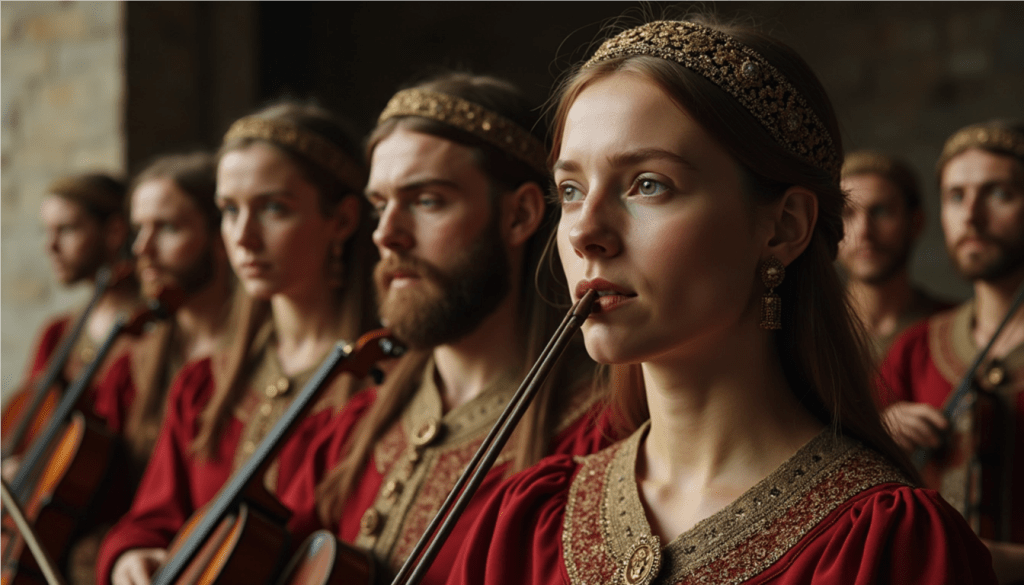
When we think of medieval Britain, it’s easy for the mind to conjure images of knights, castles, and monks toiling away in candlelit scriptoriums. But alongside the clinking of armour and the chanting of prayers, there was another ever-present element of daily life – music.
From the lofty halls of royalty to the bustling village square, music played a vital role in medieval society – not merely as entertainment, but as a means of worship, storytelling, ceremony, and community cohesion.
A Soundtrack To Everyday Life
Life in medieval Britain was steeped in ritual and tradition, and music was woven into almost every aspect of that existence. Whether it was the tolling of church bells, the plaintive strains of a minstrel’s lute, or the rousing rhythms of a village dance, music served as a living soundtrack to medieval life.
In an era before modern media, music was one of the few ways people could express emotion, share stories, and pass down history. It was also a powerful communal activity – something people gathered around, participated in, and found identity through. Music marked the rhythm of the seasons, the passing of the hours, and the major events of a person’s life – birth, marriage, and death.
Sacred Sounds: Music And The Church
The Church was undoubtedly the most powerful institution in medieval Britain, harnessing music as a means of devotion and spiritual control. Gregorian chant, named after Pope Gregory I, dominated religious music in the early medieval period. This type of plainchant was monophonic, meaning it consisted of a single melodic line, sung in Latin by monks during Mass and other services.
As the centuries progressed, the Church’s music grew more complex, giving rise to polyphony (multiple simultaneous vocal lines) in cathedrals and abbeys across the land. Composers like John Dunstaple, one of England’s most celebrated early musicians, helped shape this movement in the 15th century.
For the ordinary worshipper, church music was both awe-inspiring and instructive. Most people couldn’t read or write, so music – often filled with biblical stories and moral teachings – became a key way of understanding the faith and participating in communal worship.
Courtly Music: Nobility And The Arts
In noble courts and great halls, music was a marker of sophistication and status. Lords and ladies would employ musicians and troubadours to entertain guests, often with songs of chivalry, romance, and adventure. The themes of courtly love – noble, unattainable affection, usually for someone of higher status – were frequently sung to the accompaniment of lutes, harps, and recorders.
These songs weren’t just frivolous entertainment; they were vehicles for social commentary, satire, and coded political messages. A sharp-witted bard could praise or poke fun at a noble patron, all within the safety of poetic licence. For nobility, being a patron of the arts and music was also a way of displaying power and refinement – the medieval equivalent of owning a gallery or sponsoring an orchestra today.
Folk Traditions And Village Life
In the towns and villages, music was an integral part of daily and seasonal life. Folk music – passed down orally from generation to generation – was used to mark festivals, sowing and harvest seasons, religious holidays, and weddings. Instruments like the hurdy-gurdy, bagpipes, whistles, and fiddles were commonplace, and many a village green rang out with music and laughter during fairs and feast days.
Ballads and story-songs were especially popular. These were essentially the news broadcasts and soap operas of the day – dramatic tales of love, war, betrayal, and heroism, usually based on real or semi-mythical events. They served to educate, entertain, and reinforce cultural values, and they had a communal character that brought people together.
In many ways, folk music was the glue that bound communities – it gave people shared songs, dances, and stories that fostered a sense of belonging and continuity, even in times of hardship.
Music As A Profession
While many people played music informally, there were also professional musicians in medieval Britain, who were valued members of society. These included minstrels, who travelled between towns and courts, performing songs and stories for food, lodging, or coin. Others found employment in noble households or city guilds.
By the later Middle Ages, some cities had their own musicians’ guilds, especially in places like York and London. These organisations gave musicians a form of respectability and legal protection, much like modern trade unions.
Instruments Of The Age
Medieval music was played on a wide variety of fascinating instruments, many of which were precursors to modern ones. These included:
- Lute – the ancestor of the modern guitar, commonly used in court music.
- Harp – associated with Celtic traditions, widely used in Wales, Scotland, and Ireland.
- Rebec – a bowed string instrument, often used for dance music.
- Pipe and tabor – a whistle and drum combination played by a single performer.
- Psaltery – a plucked string instrument played on the lap, similar to a zither.
Each of these instruments added unique textures and tones to the medieval soundscape, and their use varied by region and social class.
A Sound Legacy
The importance of music in medieval Britain cannot be overstated. It was a vehicle of power, piety, passion, and protest. It connected people to their faith, their communities, their rulers, and even to the wider world, as melodies and instruments travelled through trade and conquest.
Many of the structures of modern British music – from choral traditions and church hymns to folk ballads and storytelling through song – have their roots in this rich medieval heritage. Even now, medieval music continues to inspire composers, scholars, and performers, while early music festivals and historical re-enactments celebrate its enduring legacy.
 Superlocrian