
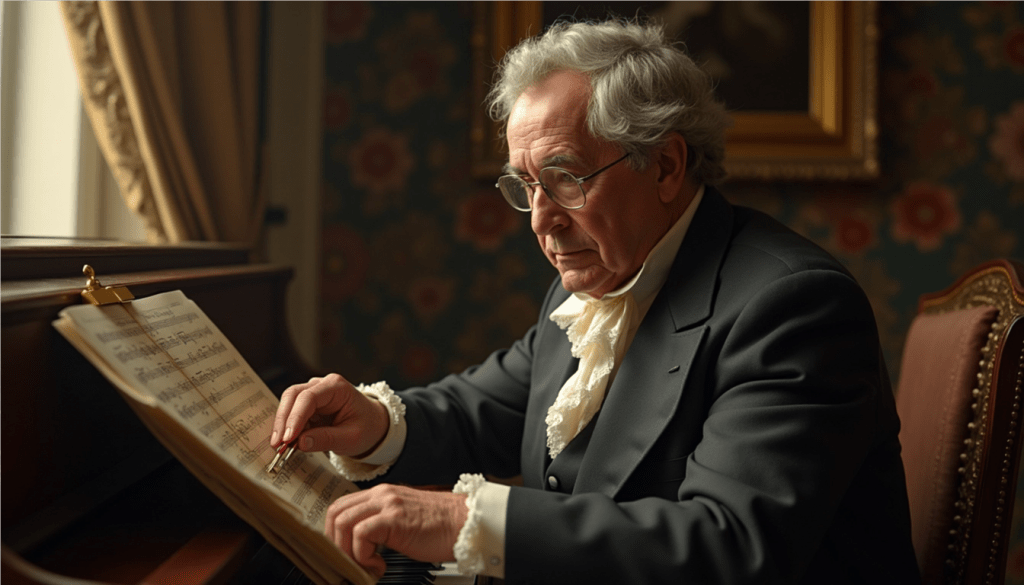
Classical music is often seen as an elite art form, regarded as inaccessible to the masses. But behind the harmonious symphonies and majestic concertos lies the story of individuals—composers whose lives were often filled with struggle, personal battles, and deep emotional complexity. These figures, though often celebrated for their musical genius, lived lives full of hardship and perseverance, their personal stories intricately tied to the music we revere today.
In this article, we delve into the hidden lives of three of the most famous classical composers: Ludwig van Beethoven, Pyotr Ilyich Tchaikovsky, and Frédéric Chopin. By examining their struggles, triumphs, and the emotional depth of their music, we can gain a richer understanding of how their personal lives shaped their timeless compositions.
Ludwig Van Beethoven: A Triumph Over Adversity
Beethoven’s story is one of monumental resilience. Born in 1770 in Bonn, Germany, Beethoven’s early life was marked by personal tragedy. His father, a strict and abusive alcoholic, pushed Beethoven into music from a young age, attempting to force him into a child prodigy role similar to Mozart. While Beethoven’s musical talent was undeniable, his childhood was far from the idyllic image we might imagine for a future genius.
As he grew older, Beethoven began to suffer from a profound hearing loss. By his late 20s, he was almost completely deaf, an obstacle that seemed insurmountable for a composer. Imagine creating symphonies, sonatas, and concertos while being unable to hear your own creations. Yet rather than retreating into despair, Beethoven’s deafness spurred him to create some of his most revolutionary works.
His Ninth Symphony, one of the most iconic pieces of classical music, was written while Beethoven was almost completely deaf. The symphony’s final movement, the Ode to Joy, represents the triumph of the human spirit over adversity—a fitting reflection of Beethoven’s own life. In many ways, his struggles with his hearing loss only deepened the emotional resonance of his music. His works became increasingly personal and expressive, marking a shift from the classical to the romantic era in music.
Beethoven’s ability to compose despite his growing isolation is a testament to his determination and belief in the power of music. His legacy is not just one of artistic achievement but of overcoming the most severe of personal struggles. His music remains a powerful reminder of the triumph of the human spirit in the face of adversity.
Pyotr Ilyich Tchaikovsky: The Burden Of Emotion
Unlike Beethoven, Tchaikovsky’s struggles were more emotional and psychological than physical.
Born in 1840 in Russia, Tchaikovsky was a deeply sensitive soul who grappled with inner turmoil throughout his life. As a young man, he struggled with his identity, and the pressure to conform to societal expectations weighed heavily on him. Tchaikovsky’s homosexuality, which he had to keep hidden due to the conservative nature of 19th-century Russian society, compounded his feelings of isolation and alienation.
Tchaikovsky’s emotional struggles are evident in his music, which often conveys deep sorrow, yearning, and melancholy. Works like Swan Lake, The Nutcracker, and Romeo and Juliet reflect the intensity of his personal life. His Symphony No. 6 in B minor (the Pathétique), which premiered just days before his death in 1893, is perhaps the most telling example of how his personal anguish infused his music. The symphony’s hauntingly beautiful themes and its tragic final movement are often interpreted as a musical reflection of Tchaikovsky’s own despair, his yearning for love and acceptance, and his internal struggle.
Tchaikovsky’s life was filled with emotional conflict, but his music transcends his personal pain. He was an artist who channelled his vulnerabilities into his compositions, creating works that resonate with listeners on a deeply emotional level. In a sense, his music became his voice, speaking in ways words could not. The emotional depth of his works remains a profound testament to the power of music as a form of emotional expression.
Frédéric Chopin: A Life In The Shadows
Frédéric Chopin, born in 1810 in Poland, led a life that was both artistically brilliant and personally tragic. Unlike Beethoven and Tchaikovsky, Chopin’s struggles were physical in nature—he battled chronic ill health for much of his life, a condition that left him frail and often bedridden. His most significant battle was with tuberculosis, which ravaged his body and ultimately led to his premature death at the age of 39.
Chopin’s health problems made it difficult for him to perform in public, and as a result, he became more reclusive over time. Instead of touring the world as many other composers of his era did, he focused primarily on composing for the piano, his instrument of choice. This gave rise to a body of work that is intimate and introspective, reflecting his own fragile health and inner world. His nocturnes, études, mazurkas, and polonaises, though delicate and graceful, often convey a sense of melancholy and longing, perhaps mirroring Chopin’s own desire for escape from the confines of his ill body.
His relationship with the French writer George Sand (who was, at the time, an infamous figure in Parisian society) provided some solace, but it was also turbulent. The emotional strain of their partnership, combined with his worsening health, deeply influenced his music. Chopin’s Ballade No. 1 in G minor and Prelude in E minor are prime examples of how his personal turmoil found expression in his compositions.
Despite his fragile health, Chopin’s music is imbued with emotional depth and technical brilliance. His intimate, lyrical compositions continue to captivate audiences and piano students alike. Through his music, Chopin left a legacy of delicate beauty that endures beyond his own personal struggles.
Music As A Reflection Of Life
The lives of Beethoven, Tchaikovsky, and Chopin show us that classical composers were not mere creators of beautiful sounds—they were complex individuals whose personal battles shaped the music they composed. Their triumphs, struggles, and emotional depths are woven into every note, creating works that resonate with audiences on a profoundly human level.
Whether through Beethoven’s defiance in the face of deafness, Tchaikovsky’s emotional vulnerability, or Chopin’s quiet, introspective melodies, these composers used their art to process their lives. In turn, their music allows us to connect with their stories and with the broader human condition.
 Superlocrian