
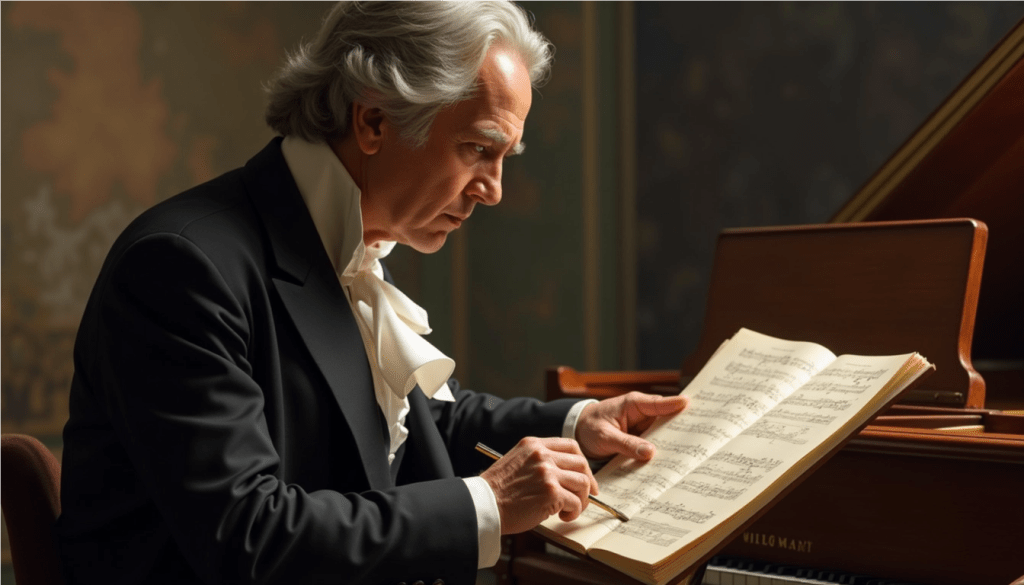
Classical music has often been described as a universal language, but this is a simplification of its complexity.
While the melody, harmony, and rhythm of a piece are the obvious elements that communicate emotion and meaning, there is another layer to classical music that is often overlooked: the language of the score itself.
The score is not merely a set of instructions to play the notes. It’s a deeply nuanced text, full of hidden meaning, emotion, and stories that go far beyond what is heard. Composers, both past and present, have long used the language of music to express ideas, moods, and even abstract thoughts that words cannot capture.
In this blog post, we’ll explore how composers use notation, dynamics, and tempo markings to communicate far more than just a melody — offering a deeper understanding of their works.
The Score: More Than Just Notes
At its most basic level, a musical score is a written representation of the notes a composer intends for performers to play. However, this representation is far from literal.
For instance, beyond the notes themselves, composers use a wide variety of symbols to convey specific instructions about how the music should be played. These include dynamics (volume), articulation (how notes are played), tempo (speed), and expression marks (mood). Together, these elements create a rich language that gives performers the freedom to interpret the music as they see fit, while still staying true to the composer’s intent.
For example, consider Beethoven’s famous Symphony No. 5. The first movement is marked “Allegro con brio,” meaning “fast with spirit”. This direction is not merely a suggestion of tempo; it tells the performer to infuse the music with energy and determination, capturing the essence of struggle and triumph. Beethoven’s use of dynamics — the repeated, forceful forte (loud) passages contrasted with softer piano (quiet) sections — serves to heighten the drama.
The score, in this sense, is a blueprint for emotional communication, allowing the music to speak directly to the listener’s subconscious.
Dynamics: The Emotional Palette
One of the most powerful tools in a composer’s arsenal is the manipulation of dynamics. These markings tell the performer how loud or soft to play, but their emotional significance goes far beyond that. The choice of dynamic — whether it’s a gentle pianissimo (very soft) or a powerful fortissimo (very loud) — can shift the emotional tone of a piece, giving the music its unique character.
Take Mozart’s Requiem Mass in D Minor, for example. The Lacrimosa movement opens with a quiet, almost haunting piano dynamic, evoking a sense of sorrow and loss. As the choir and orchestra swell, the dynamic grows to a rich forte, conveying the emotional weight of mourning. This dynamic contrast mirrors the journey from quiet grief to emotional release, creating a profound listening experience.
In the case of Beethoven’s Moonlight Sonata, the first movement uses a consistently soft dynamic to create a tranquil, almost ethereal atmosphere. Yet, despite its quiet nature, the movement is filled with an emotional intensity that can only be understood when considering the composer’s detailed use of dynamics. It’s a perfect example of how soft sounds can be just as expressive as louder ones, allowing for subtle shifts in mood and tension.
Tempo: The Pace Of Emotion
Tempo markings are another essential part of the composer’s hidden language. A composer’s choice of speed can convey a wide range of emotional states. A brisk allegro (fast) tempo might suggest excitement or joy, while a slower adagio (slow) tempo evokes contemplation, sadness, or introspection. But tempo can also function in more intricate ways. A sudden change in tempo, known as a ritardando (slowing down), can signal a dramatic pause, allowing the emotional weight of a passage to fully settle in.
Consider Tchaikovsky’s Swan Lake, where tempo shifts are used to depict the dance of the swans. The music moves from a lively tempo during the majestic opening dance to a much slower, more melancholic pace as the tragic love story of Odette and Siegfried unfolds. This contrast in speed allows the audience to feel the tension between the joy of the dance and the impending sadness of the narrative.
Articulation: How A Note Is Played
The way a note is played — whether it’s short and detached (staccato) or long and smooth (legato) — can significantly alter the meaning behind a piece.
Composers use articulation marks to indicate how they envision the note or phrase being expressed. A staccato passage, where notes are played sharply and briefly, might evoke a playful or even nervous energy. Conversely, legato phrasing, where notes are connected seamlessly, communicates a sense of smoothness and elegance.
An excellent example of this can be found in Chopin’s Ballade No. 1 in G minor. The composer’s frequent use of both staccato and legato gives the piece an emotional ebb and flow, moving between sections of nervous energy and more lyrical, heartfelt passages. The contrast between these articulations tells a story of conflict, resolution, and longing — all within the framework of a single piece.
Expression: The Composers’ Voice
Composers also use additional expression marks to guide performers in their interpretation of a piece. Terms such as espressivo (expressively), dolce (sweetly), or agitato (agitated) give the performer insight into the emotional direction of a passage. These markings offer clues that help unlock the deeper meaning of the music. But they also leave room for interpretation, which is one of the most exciting aspects of classical music performance.
Consider the famous Adagio for Strings by Samuel Barber. While the score may indicate a slow tempo, it’s the term espressivo that guides performers to infuse the piece with the profound sorrow and yearning it is known for. The emotional impact of this piece is largely a result of how the performers interpret and execute these expressive markings, which speak to the heart of the music in ways words cannot.
The Music Speaks Beyond The Notes
The next time you sit down to listen to a classical piece, consider the hidden language of the score. Beyond the notes, dynamics, tempo markings, and articulations lie emotional and intellectual messages that are carefully crafted by the composer. These markings are not simply instructions; they are a means of communication that speaks directly to the performer and, through them, to the listener.
Through this intricate system of notation, composers have created a vast and expressive language that goes beyond words, allowing their music to speak volumes about the human experience.


Leave a Reply