
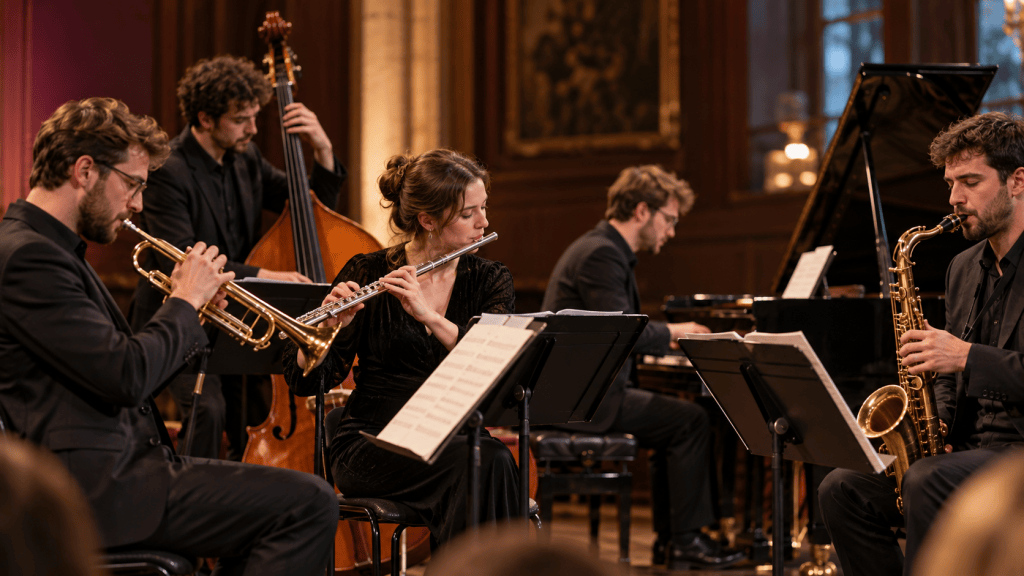
Jazz and classical music are often treated as two very different musical worlds. Classical music is commonly associated with detailed scores, carefully structured compositions and orchestral performances, while jazz is celebrated for improvisation, rhythmic freedom and the individuality of its performers.
However, these traditions have far more in common than many people realise. Both place enormous importance on musicianship, interpretation, harmony and the ability of performers to communicate through music.
Chamber jazz brings elements of these musical worlds together, creating a distinctive style that combines the intimacy of small-ensemble performance with the expressive possibilities of jazz and the compositional sophistication associated with classical music.
For listeners who enjoy discovering new musical styles, chamber jazz offers an opportunity to experience familiar instruments, melodies and musical ideas in unexpected ways.
In this guide, we explore what chamber jazz is, how it differs from traditional jazz and classical music, the instruments commonly involved, and why this form of musical crossover continues to interest composers, performers and audiences.
What Is Chamber Jazz?
Chamber jazz is a style of music that combines elements of jazz with the musical characteristics of chamber music. It often features relatively small ensembles, intricate arrangements, acoustic instruments and close interaction between performers.
The term does not describe one rigidly defined genre. Some chamber jazz groups lean towards traditional jazz, while others incorporate classical composition, contemporary music, folk influences or other musical traditions.
What often distinguishes chamber jazz is the balance between composition and individual expression. A performance might contain carefully written passages, sophisticated harmonies and complex instrumental arrangements while still allowing musicians to respond to one another and introduce elements of spontaneity.
Unlike a large orchestra or traditional big band, a chamber ensemble generally allows individual instruments to be heard more clearly. Each performer can contribute something distinctive to the overall sound, whether through a melodic line, a harmonic accompaniment, a rhythmic figure or a solo passage.
The result can be music that feels intimate and detailed without sacrificing the excitement and expressive freedom associated with jazz.
Importantly, chamber jazz does not have to be completely acoustic, exclusively classical in its influences or heavily improvised. Different ensembles approach the style in different ways, making it a broad and flexible musical category.
What Is Chamber Music And How Does It Influence Jazz?
To understand chamber jazz, it helps to understand chamber music itself.
Chamber music developed around performances for small groups of musicians, traditionally in domestic rooms, private gatherings and smaller venues rather than large concert halls. The word chamber reflects this historical association with music performed in relatively intimate settings.
In chamber music, performers typically have individual musical parts rather than simply doubling the same line. Each part contributes to the overall composition, and the musicians must listen carefully to one another to maintain balance, timing and expression.
A string quartet is one of the best-known examples, traditionally consisting of two violins, a viola and a cello. However, chamber music can be written for many different combinations of instruments.
This emphasis on individual parts and musical interaction has interesting implications for jazz.
In a large ensemble, an individual instrument may sometimes be part of a larger section performing together. In a chamber setting, the relationship between performers can become more immediate, with each musician contributing a distinctive voice.
The musicians might exchange melodic ideas, support another player’s phrase or alter their interpretation in response to what they hear.
For jazz musicians, this creates opportunities for subtle communication and improvisation. For listeners, it makes the details of the arrangement easier to appreciate.
How Does Chamber Jazz Differ From Traditional Jazz?
Jazz encompasses an enormous range of styles, from early jazz and swing to bebop, hard bop and contemporary improvisational music. Consequently, there is no single traditional jazz sound against which all chamber jazz can be compared.
Nevertheless, several characteristics can help explain the distinction.
Instrumentation and ensemble size
Many jazz groups use combinations of trumpet, saxophone, piano, double bass and drums. Big bands expand this approach with larger sections of brass, woodwind and rhythm instruments.
Chamber jazz often uses smaller acoustic ensembles and may incorporate instruments associated with classical music, including flute, oboe, clarinet, strings or unusual combinations of brass and woodwind.
Some groups use very little conventional rhythm-section instrumentation, creating rhythm through the interaction of the melodic instruments themselves.
Composition and arrangement
Improvisation is central to many jazz traditions, but chamber jazz often places particular emphasis on detailed arrangements and compositional structure.
The music might feature carefully coordinated entrances, contrasting instrumental textures, unusual harmonies and passages where different musicians perform independent melodic lines.
Improvisation can still be important, but it exists alongside a more explicitly shaped compositional framework.
Musical texture
Chamber jazz often makes use of transparency: the ability to hear the individual elements within an arrangement.
Rather than relying on volume or a dense instrumental texture, composers can create interest through subtle changes in register, rhythmic patterns, harmony and the relationships between instruments.
These qualities do not make chamber jazz inherently more sophisticated than other forms of jazz. They simply create a different listening experience, one that often rewards attention to the smaller details of a performance.
How Does Classical Music Influence Chamber Jazz?
Classical music offers a rich source of ideas for chamber jazz composers and arrangers.
One important influence is counterpoint, a compositional technique in which two or more independent melodic lines work together. Instead of one instrument playing the melody while everything else supports it, several instruments can develop their own musical ideas simultaneously.
This can create an intricate sound in which individual lines remain distinct while contributing to a unified whole.
Harmony is another important area of crossover. Classical composition provides a wide range of techniques for building harmonic tension, creating unexpected transitions and developing musical ideas over time. Combined with jazz harmony, these approaches can produce sophisticated and sometimes surprising results.
Classical music can also influence the overall structure of a composition. A piece might develop through contrasting sections, recurring themes, changes in texture or the gradual transformation of an initial musical idea.
Orchestration is equally important. By considering the different qualities of brass and woodwind instruments, composers can create contrasts between bright, powerful passages and softer, more reflective moments.
These influences do not mean chamber jazz simply adds improvisation to classical music. The relationship can work in both directions, with jazz rhythms, harmonic language and expressive freedom changing how classical techniques are used.
The most interesting results often come when the musical traditions interact naturally rather than when one is simply added to the other.
What Instruments Are Used In Chamber Jazz?
One of the most appealing aspects of chamber jazz is the variety of instrumental combinations it can accommodate.
Unlike genres defined by a relatively standard line-up, chamber jazz can sound very different depending on the instruments involved and the musical approach of the ensemble.
Common possibilities include:
- Trumpets and flugelhorns: These brass instruments can provide bright, powerful melodic lines or softer, more lyrical passages.
- Saxophones: Their versatility makes them useful for expressive melodies, improvised solos and complex harmonies.
- Flutes and other woodwind instruments: These can introduce lighter textures, delicate melodic details and contrasting colours.
- Trombones and tubas: These instruments contribute depth to the ensemble, supporting the harmony while also creating distinctive melodic and rhythmic effects.
- Piano and strings: Some chamber jazz groups use piano, violins, violas or cellos to broaden their harmonic and textural possibilities.
- Double bass and percussion: Depending on the arrangement, these instruments can provide rhythmic foundations without dominating the ensemble.
The combination of instruments matters as much as the individual instruments themselves.
For example, several brass instruments can create rich, closely voiced harmonies that change dramatically as different notes move through the arrangement. A flute playing above a lower brass line can introduce a completely different atmosphere, even when the underlying harmony remains unchanged.
Composers can also exploit the differences between instruments that might rarely appear together in more conventional musical settings.
These possibilities allow chamber jazz to move between styles and moods, from lively rhythmic passages to atmospheric, reflective music.
Is Chamber Jazz Improvised Or Written In Advance?
One common misconception is that jazz must be improvised while classical music must be written down.
In reality, both traditions encompass a wide range of approaches to composition and performance.
Jazz musicians frequently work with arrangements, chord progressions, written melodies and predetermined structures. Classical musicians, meanwhile, make countless interpretative decisions about phrasing, tempo, dynamics and expression, even when performing music that has been carefully notated.
Chamber jazz brings these approaches together in different ways.
Some compositions are tightly arranged, with performers following detailed written parts throughout. Others incorporate improvised solos, flexible sections or opportunities for musicians to respond more spontaneously to one another.
Even when every note is written in advance, individual performers still influence the result through tone, articulation, timing and phrasing.
A single melody can sound dramatically different depending on how a musician shapes its notes or interacts with the surrounding instruments.
This balance between preparation and individual expression is part of what makes ensemble music so compelling. The written arrangement provides a framework, while the performers bring that framework to life.
Why Is Chamber Jazz Worth Listening To?
For listeners unfamiliar with chamber jazz, the genre offers several ways to discover something new about music.
First, it can provide a bridge between classical and jazz traditions. Someone who enjoys orchestral music might appreciate the intricate arrangements and instrumental colours, while a jazz enthusiast might be drawn to the rhythmic energy and opportunities for improvisation.
Second, chamber jazz encourages attentive listening. With fewer instruments competing for attention, it can be easier to notice the relationship between individual musical parts.
A secondary melody might emerge briefly before disappearing into the background. A rhythmic figure introduced by one instrument might be developed by another. A change in harmony could transform the atmosphere of an entire passage.
These details can make repeated listening particularly rewarding.
Chamber jazz can also challenge assumptions about musical genres. Rather than treating jazz and classical music as separate categories, it demonstrates how composers and performers can combine techniques from different traditions to create something distinctive.
The experience does not require specialist knowledge. Simply listening for changes in texture, the interaction between instruments and the way musical ideas develop can reveal a great deal about what is happening within a piece.
How To Start Exploring Chamber Jazz
If you are new to chamber jazz, listening for specific musical details can make the experience more engaging.
Start by paying attention to the instrumentation. Notice whether the ensemble uses brass, woodwind, strings, piano or percussion, and consider how each instrument contributes to the overall sound.
Next, listen for the relationship between the melody and the supporting parts. Does one instrument carry the main tune while others provide accompaniment, or do several independent melodies develop at the same time?
It is also worth noticing how the music moves between composed passages and improvisation. Some performances maintain a carefully organised structure throughout, while others allow individual musicians more freedom to introduce ideas or respond to their fellow performers.
Finally, listen to the way the musical atmosphere changes. Variations in dynamics, rhythm, harmony and instrumental combinations can create tension, excitement, calm or intimacy without requiring dramatic changes in volume.
You do not need to identify every chord or understand every compositional technique. Listening with curiosity is enough to begin recognising the details that make chamber jazz distinctive.
Exploring recordings by different ensembles can also reveal how broad the style is. One group might emphasise intricate arrangements and classical influences, while another prioritises improvisation and rhythmic energy.
There is no single formula for chamber jazz, and discovering these different approaches is part of its appeal.
The Future Of Chamber Jazz
Chamber jazz demonstrates that musical traditions do not have to remain within fixed boundaries.
By bringing together carefully crafted arrangements, instrumental subtlety and the expressive qualities of jazz, the genre creates opportunities for composers and performers to explore new musical possibilities.
Its flexibility is part of its appeal. Some ensembles favour intimate acoustic textures, while others incorporate bold brass arrangements, contemporary harmonies or influences from other musical cultures.
There is no single formula for what chamber jazz should sound like. Instead, its identity develops through the decisions made by the musicians who perform and compose it.
For listeners, that creates an opportunity to discover music that combines the detailed craftsmanship of chamber performance with the energy, colour and expressive freedom of jazz.
Whether you come to it through classical music, improvisation or a general curiosity about how instruments interact, chamber jazz offers a rewarding reminder that some of the most interesting musical experiences happen where different traditions meet.
Frequently Asked Questions About Chamber Jazz
Is chamber jazz a type of classical music or jazz?
Chamber jazz is generally considered a style of jazz that incorporates elements of chamber music and classical composition. However, individual ensembles vary in how strongly they draw on each tradition.
Does chamber jazz always include improvisation?
No. Some chamber jazz performances include extensive improvisation, while others rely more heavily on carefully written compositions and arrangements. Many combine both approaches.
What is the difference between chamber jazz and classical chamber music?
Classical chamber music generally centres on composed works performed by small ensembles, often with one musician playing each part. Chamber jazz introduces jazz influences, which may include jazz harmony, rhythmic approaches, improvisation and more spontaneous interaction between performers.
Is chamber jazz suitable for beginners?
Absolutely. Listeners do not need any formal musical training to enjoy it. Paying attention to the relationship between instruments, changes in mood and the development of melodies is a good way to begin appreciating the style.
Where can I listen to chamber jazz?
Chamber jazz can be discovered through streaming platforms, recorded albums, live concerts and specialist jazz ensembles. Exploring recordings by different groups can help you appreciate the range of approaches within the genre, from tightly composed instrumental arrangements to performances that leave more room for improvisation.

