
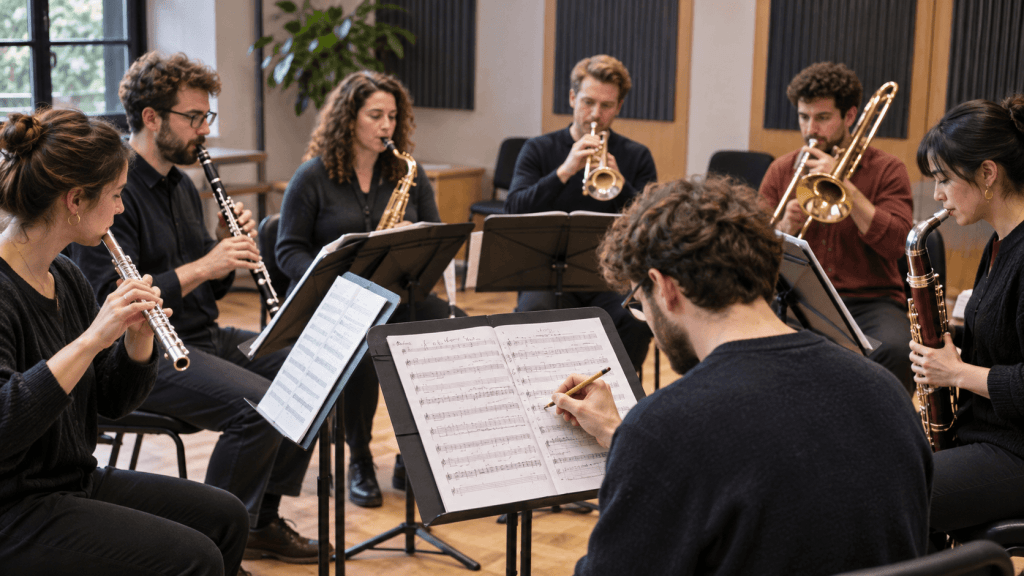
Have you ever listened to a piece of music and wondered how it came into existence? Behind every memorable melody, intricate harmony and carefully timed musical passage is a creative process that transforms an initial idea into something that can be performed and enjoyed by an audience.
Creating music involves much more than simply putting notes on a page. Composers must develop musical ideas, experiment with different sounds, consider how instruments work together and make countless creative decisions along the way. When a piece is ready to be performed, musicians then bring those ideas to life through interpretation, collaboration and rehearsal.
Whether it is an entirely original composition or a fresh arrangement of an existing piece, the journey from the first musical idea to a finished performance is an intricate and fascinating process.
Where Do Composers Get Their Musical Inspiration?
Every musical composition begins somewhere, but there is no single formula for finding inspiration. Some composers start with a melody that comes into their head, while others might begin with a rhythm, a chord progression or even a particular sound they want to explore.
Inspiration can come from almost anywhere. A composer might be influenced by a personal experience, a memorable place, a piece of literature or another musical style. Some draw heavily on existing musical traditions, while others deliberately experiment with unfamiliar sounds and techniques.
For example, jazz composers might take inspiration from the rhythms and harmonies associated with improvisation, whereas classical composers might explore more structured musical forms or develop themes through complex orchestration.
Sometimes, a composition starts with something remarkably simple. A short melodic phrase or rhythmic pattern can provide the foundation for an entire piece of music.
The important thing is that the initial idea is only the beginning. Developing it into a complete composition requires imagination, experimentation and an understanding of how different musical elements work together.
How Does A Composer Develop An Initial Musical Idea?
Once a composer has an initial idea, the next stage involves developing it into something more substantial.
This usually means exploring several fundamental elements of music, including melody, harmony, rhythm and structure.
Melody
Melody is often the most immediately recognisable element of a composition. It is the sequence of notes that forms the main musical theme, creating something that listeners can follow, remember and recognise.
Composers might develop a melody by repeating certain phrases, changing their direction or introducing variations that give the music a sense of progression.
Harmony
Harmony refers to the way different notes are combined to support and complement the melody.
The choice of chords can have a significant influence on how a piece of music sounds and feels. Certain harmonic combinations create a sense of resolution and familiarity, while others introduce tension, uncertainty or unexpected changes in direction.
Rhythm
Rhythm provides the movement and energy within a composition. It determines how notes are organised in time and influences the overall character of the music.
A steady rhythm might create a sense of stability, whereas more complex or unpredictable rhythmic patterns can make a composition feel energetic, playful or dramatic.
Structure
A composition also needs some form of structure. This determines how the different musical ideas are organised and how the piece develops from beginning to end.
Some composers use established musical forms, while others prefer a more experimental approach.
As these elements gradually come together, an initial musical idea develops into a composition with its own identity, character and direction.
What Is The Difference Between Composition And Arrangement?
Although the terms composition and arrangement are sometimes used interchangeably, they describe two different aspects of music creation.
Composition involves creating an original piece of music. A composer develops the musical ideas, melodies, harmonies and structure that form the foundation of the work.
Arrangement, on the other hand, involves adapting existing music for a particular group of instruments, performers or musical style.
For example, an arrangement might take a well-known jazz standard originally written for a big band and rework it for a smaller chamber ensemble. The central melody and recognisable musical themes might remain, but the instrumentation, harmonies and overall sound could be quite different.
Arranging is not simply a matter of allocating existing notes to different instruments. A skilled arranger considers how the music can be adapted to make the most of the performers and instrumentation available.
This might involve rewriting certain passages, introducing new harmonies, creating instrumental solos or completely rethinking how different sections of the music interact.
The result can be something that feels familiar while offering a fresh musical perspective.
How Are Instruments Assigned Different Musical Parts?
One of the most interesting aspects of composition and arrangement is deciding which instruments should perform particular musical roles.
Different instruments have distinctive characteristics. Some produce bright, powerful sounds, while others are capable of softer, more delicate tones. Their individual ranges, playing techniques and tonal qualities all influence how they can be used within a composition.
In an ensemble combining brass and woodwind instruments, for example, a composer has a particularly varied collection of sounds to work with.
Trumpets can provide bright melodies and powerful musical statements, while trombones offer a rich tone that can add depth and weight to an arrangement. Flutes can introduce light, delicate passages, while saxophones offer considerable versatility, moving between lyrical melodies, rhythmic parts and more expressive jazz-inspired passages.
Lower-pitched instruments, such as tubas, can provide a strong harmonic foundation, helping to support the other musicians and give the music greater depth.
Of course, these roles are not fixed. A good composition or arrangement makes use of the individual strengths of each instrument while allowing musicians to take on different roles throughout the piece.
Some passages might feature one instrument performing the main melody, while others bring several instruments together to create richer harmonies or more complex musical textures.
The challenge for composers and arrangers is to ensure that everything works together as a coherent musical whole.
What Happens During Rehearsals Before A Performance?
Once a composition or arrangement has been written, it needs to be brought to life by musicians.
This is where rehearsals become essential.
Even when musicians are highly experienced and technically accomplished, performing a new piece of music requires time, preparation and collaboration.
During the early stages of rehearsal, musicians will typically work through the composition to familiarise themselves with their individual parts and understand how everything fits together.
They will pay attention to details such as timing, dynamics, articulation and phrasing. These elements might appear relatively small when viewed on a musical score, but they can have a considerable impact on the overall performance.
Getting The Timing Right
Musicians need to maintain a consistent sense of tempo and ensure that their individual parts remain synchronised.
This can be particularly important in smaller ensembles, where performers must listen carefully and respond to one another rather than relying entirely on a conductor.
Balancing The Instruments
An arrangement might contain several instruments performing simultaneously, but this does not necessarily mean that they should all be equally prominent.
Musicians need to understand when to bring their parts forward and when to support other performers. This ensures that important melodies remain clear and that the overall sound is balanced.
Developing Musical Expression
Technical accuracy is only one part of a successful performance. Musicians also need to consider how to communicate the intended character and emotion of the composition.
Changes in volume, tempo, articulation and phrasing can all help create a more engaging interpretation.
As rehearsals progress, musicians become increasingly familiar with the composition. They can begin to explore its subtleties, experiment with different interpretations and develop a greater understanding of how their individual contributions affect the overall sound.
Bringing The Music To Life Through Performance
A musical score provides the framework for a composition, but it is the musicians who ultimately bring it to life.
Even when two groups perform exactly the same piece of music, the results can be noticeably different. Every musician brings their own interpretation, experience and personality to a performance.
This is particularly apparent in jazz, where improvisation can play an important role.
Rather than following every note exactly as written, performers might introduce spontaneous musical ideas, vary certain passages or respond creatively to what other musicians are playing.
In chamber music, collaboration is equally important. Musicians need to listen closely to one another, adapt their playing and respond to subtle changes in expression and timing.
The relationship between the individual performers is therefore just as important as the notes themselves.
This is one of the reasons why live music can be such a rewarding experience. Even when audiences are familiar with a particular composition, every performance offers the possibility of something slightly different.
The Creative Process Behind Every Musical Performance
From the first spark of inspiration to the final note of a live performance, creating music involves a combination of artistic vision, technical knowledge and collaboration.
Composers develop original musical ideas, arrangers adapt existing works for different performers and instruments, and musicians interpret those ideas through practice and performance.
Each stage contributes something important to the finished result. But ultimately, whether a piece of music is entirely original or a fresh interpretation of a familiar work, its success depends on how effectively its individual elements come together.
The next time you listen to a live ensemble, take a moment to consider everything that has gone into creating the music. Behind those few minutes of performance could be hours of composition, careful arrangement, individual practice and collective rehearsal.
It is this combination of creativity and collaboration that makes the process of bringing music to life so fascinating.
Frequently Asked Questions
1. What is the difference between a composer and an arranger?
A composer creates original music, developing the melodies, harmonies and structure of a piece. An arranger adapts existing music for a particular combination of instruments, performers or musical style. Both roles require creativity and a detailed understanding of musical principles.
2. How long does it take to compose a piece of music?
There is no fixed timeframe. A relatively short composition might take a few hours or days to develop, while more complex works can take weeks, months or even years. The time required depends on the composer’s approach, the complexity of the music and how much refinement is involved.
3. Can the same piece of music be arranged for different instruments?
Yes. Many compositions can be adapted for different instrumental combinations. An arrangement for a full orchestra, for example, might sound very different when rewritten for a small chamber ensemble, even though the central musical ideas remain recognisable.
4. Why are rehearsals important for professional musicians?
Rehearsals allow musicians to become familiar with their individual parts, coordinate their timing, balance their sound and develop a shared interpretation of the music. Even highly experienced performers need to rehearse when preparing new compositions or arrangements.

